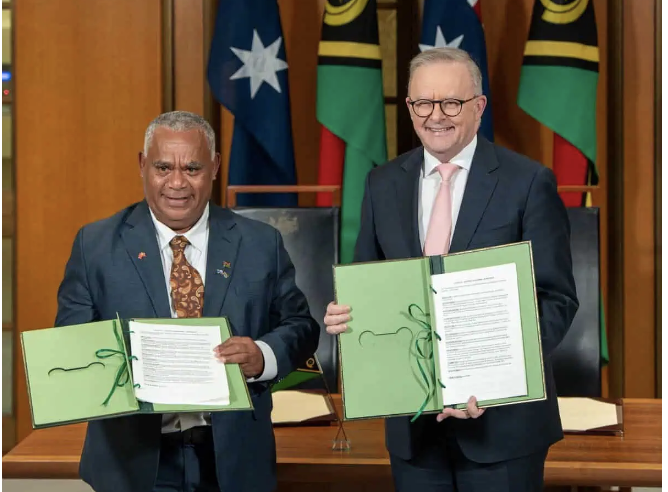
Australian Prime Minister Anthony Albanese and Vanuatu Prime Minister Jotham Napat signed the Vanuatu–Australia Nakamal Agreement in Canberra. Image: Australian Government
Australia and Vanuatu have signed the long-awaited Nakamal Agreement, concluding months of negotiations on a partnership that will shape economic, infrastructure and security cooperation between the two countries over the next decade.
The agreement was signed in Canberra on 29 June by Australian Prime Minister Anthony Albanese and Vanuatu Prime Minister Jotham Napat. It formalises Australia as Vanuatu’s preferred security and policing partner while committing Australia to provide around A$500 million in support over ten years for development priorities including infrastructure, climate resilience and institutional strengthening.
Although the agreement contains security provisions, both leaders stressed that it is equally an economic partnership designed to support Vanuatu’s long-term development.
Prime Minister Albanese said the agreement reflected Vanuatu’s sovereign decision not to allow foreign military bases or the militarisation of critical infrastructure on its territory. He described the pact as an investment in a stable, prosperous and resilient Pacific.
Prime Minister Napat said Vanuatu would continue to maintain relationships with a range of international partners while remaining transparent about the contents of the agreement. He confirmed that Vanuatu continues discussions with China on a separate economic cooperation arrangement, emphasising that the two agreements serve different purposes.
Negotiations over the Nakamal Agreement had been delayed after Vanuatu raised concerns that earlier drafts could have restricted its ability to attract infrastructure investment from other countries. The final version instead requires consultation with Australia regarding third-party involvement in critical infrastructure without preventing Vanuatu from pursuing investment from elsewhere.
The agreement is widely viewed as one of Australia’s most significant Pacific initiatives in recent years as Canberra seeks to strengthen partnerships across the region amid increasing strategic competition. While China was not named in the treaty, the agreement comes against the backdrop of Beijing’s growing infrastructure and lending presence throughout the Pacific.
For Vanuatu, the arrangement provides long-term financial certainty as the country continues rebuilding following recent natural disasters while pursuing economic diversification, improved infrastructure and stronger resilience to climate change.