Fourteen Pacific Island countries will benefit from a major climate-resilient infrastructure program backed by the Green Climate Fund (GCF) and Asian Development Bank (ADB), with investments planned in transport, water, energy, coastal protection and other essential services.
The Regional Programmatic Approach on Climate Action (RPACA), approved in late October 2026, combines a US$250 million GCF grant with approximately US$809 million in ADB co-financing. The ten-year program is expected to strengthen climate resilience for around 3.7 million people across the Pacific.
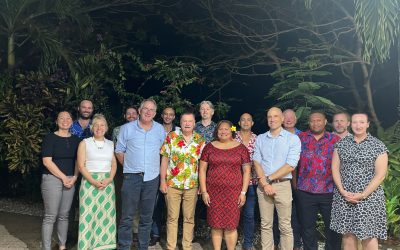
The Cook Islands and Palau co-chaired the regional working group that developed the initiative, bringing together 14 Pacific countries to identify priorities and improve access to climate adaptation financing.
In the Cook Islands, the program will support upgrades to at least four airports in the Southern Group. The improvements will strengthen transport infrastructure serving outer-island communities, where air services are essential for tourism, commerce, healthcare, supplies and emergency response.
Cook Islands Prime Minister Mark Brown welcomed the funding decision, particularly the availability of grants rather than additional government borrowing.
“We have said for years that the Green Climate Fund must work for small island countries, and that our funding needs to come as grants, not loans that add to our debt,” Brown said.
Palau is also planning investments in water infrastructure and climate-resilient housing, with approximately US$47.8 million in proposed projects.
The wider program will support the preparation and implementation of up to 21 climate-resilient infrastructure projects, addressing risks from sea-level rise, cyclones, flooding and drought.
Alongside infrastructure construction, RPACA will strengthen public financial management, climate-risk assessments and investment planning, helping participating countries develop projects capable of attracting financing.
For Australian and Pacific engineering, construction and infrastructure businesses, the program could create opportunities in project preparation, technical consultancy, design, construction and asset management.
Implementation will depend on individual country planning, project approvals and procurement processes.
In the Cook Islands, the Ministry of Finance and Economic Management and Infrastructure Cook Islands will lead implementation planning.
The program represents a substantial investment in protecting essential Pacific infrastructure while improving the region’s capacity to develop and finance future projects.